
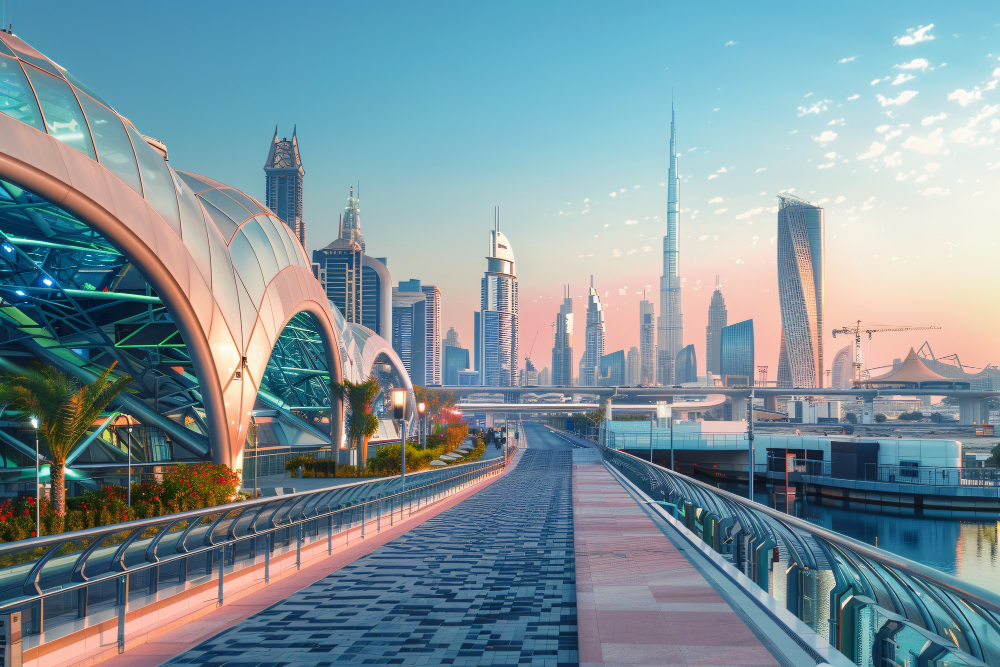
How Dubai Has Become a Global Hub for Consumer Product Trading
- By sales@ellway.ae
- 0 Comments
- Posted on
Dubai’s position in global trade is no accident.
Over several decades, the city has developed an ecosystem that connects international suppliers, logistics networks, distributors, retailers, and consumers across the Middle East and beyond.
For consumer product businesses, this makes Dubai more than a commercial destination. It is a strategic base for sourcing, distribution, and regional market expansion.
A Strategic Geographic Position
Dubai sits at the crossroads of major trade routes connecting Asia, Europe, Africa, and the Middle East.
This geographical advantage has helped the emirate develop into an important gateway for international commerce.
Its location is particularly valuable for companies serving multiple GCC markets because products can enter the region through an established network of ports, airports, roads, and distribution channels.
World-Class Logistics Infrastructure
One of Dubai’s greatest strengths is its logistics infrastructure.
Jebel Ali Port, for example, remains a critical component of the region’s trade network. In 2026, Dubai authorities highlighted the port’s multimodal capabilities and its role in maintaining regional trade flows.
Dubai has also continued investing in the integration of air and sea freight.
Dubai Customs and Emirates SkyCargo have been working to strengthen connections between air and sea cargo networks, helping businesses move products more efficiently through the region.
For consumer product businesses, efficient logistics can directly influence:
- Delivery times
- Inventory availability
- Distribution costs
- Regional market access
- Supply chain reliability
A Strong Re-Export Ecosystem
Dubai’s role is not limited to importing products for local consumption.
The emirate also serves as a major re-export and redistribution centre, allowing businesses to bring products into Dubai and distribute them to markets throughout the region.
This is particularly useful for companies working with multiple GCC markets.
Instead of managing completely separate sourcing and distribution structures for each market, businesses can use Dubai as a strategic regional base.
An International Business Environment
Dubai is home to companies and entrepreneurs from around the world.
This creates an environment where international suppliers, trading companies, distributors, retailers, and service providers can operate within a highly connected commercial ecosystem.
For consumer product businesses, this creates opportunities to build relationships across the entire supply chain.
Resilience Is Becoming Just as Important as Speed
Modern trade is not only about moving products quickly.
Recent disruptions to international shipping have highlighted the importance of resilient and flexible supply chains.
Dubai’s response in 2026 included the development of alternative trade routes and customs measures designed to keep goods moving despite pressure on traditional shipping routes.
This ability to adapt is becoming increasingly important for businesses operating across international markets.
Why Dubai Matters to GCC Consumer Product Markets
For a consumer product trading company, Dubai offers a combination that is difficult to replicate:
Global connectivity + logistics infrastructure + regional access + business networks.
This allows companies to source products internationally while remaining close to the markets they serve.
For Ellway International Trading L.L.C., being based in Dubai provides an important foundation for connecting products, suppliers, and customers across the GCC.
As consumer demand continues to evolve, Dubai’s role as a bridge between global supply and regional markets is likely to remain significant.